Positives
- Accommodates a large foot size.
- Fun to turn.
- Smooth edge control on groomed.
- More approachable compared to other Weston boards.
- Did not dominate the rider on open terrain.
Negatives
- High Camber that requires speed to flex.
- Edge Hold challenged on icy conditions
- Slow transition for heel to toe.
- Feels much bigger than a 148
- 148 is the SMALLEST option
Summary
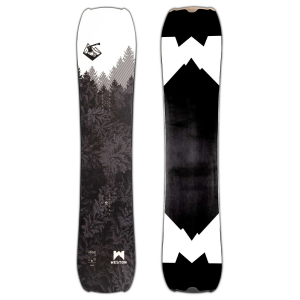
The Weston Hatchet is a unique board in that it takes a short/fat volume-shifted design to an extreme. At a size 148, the Weston Hatchet has a 26.3cm Waist Width. This is the largest length-to-width difference I have ever ridden. The volume underfoot is so wide that it can accommodate up to a W's 13 boot. Even though the board rode like a 152-154, the turning experience and overall board were really fun. The transitions from heel to toe were slow, but once on edge, the board maintained smooth edge control. The turning experience was challenged in tighter and icier conditions. Individuals with larger feet and more height/weight would have an easier time maneuvering this board.Where To Buy
No obligation, but these links support the site.
Weston

evo

Outdoor Gear Exchange

SnowCountry

No Results Found
| Riding Style | Aggressive All Mountain |
| Riding Level | Advanced - Expert |
| Fits Boot size (US) | > 12 |
| Manufactured in | China by GP87 |
| Shape | Twinish |
| Camber Profile | Mostly Camber |
| Stance | Centered |
| Approx. Weight | Feels Heavy |
| Split | Comes in split |


|
|
|
|
|
|
|
|
|
|
|
|
|
|
|
|
|
|
|
|
|
|
|
|
|
| On Snow Feel |

|
| Turn Initiation |

|
| Skidded Turns |

|
| Flex |
|
| Buttering |
|
| Edge Hold |
|
Where To Buy
No obligation, but these links support the site.
Weston

evo
Outdoor Gear Exchange
SnowCountry
No Results Found
Weston Hatchet Review by Jordan-A Women's Perspective Review by The Good Ride
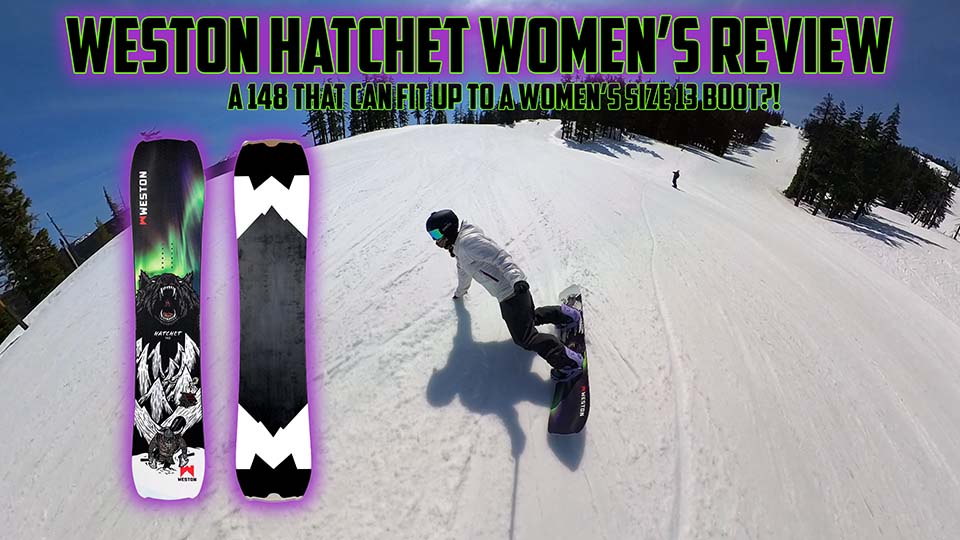
How The Weston Hatchet Was Tested By Jordan
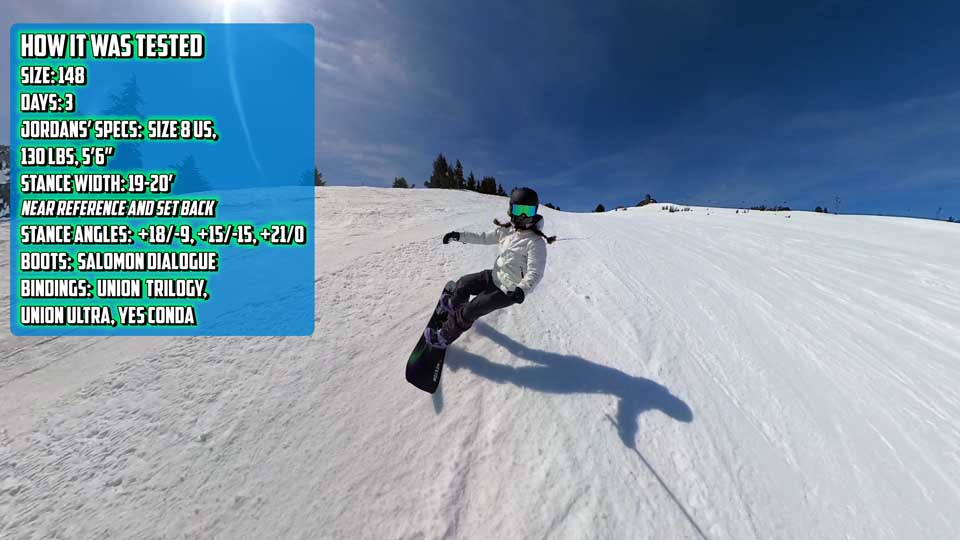
This is tested on multiple days in a variety of conditions in the Pacific Northwest. Conditions included groomed, tracked-out powder, packed powder, and pockets of deep snow. The Weston Hatchet was primarily ridden on uneven setup, snow, and groomed snow. I rode this board in a +18/-9 directional stance and set it to a reference stance width of 20, with my Trilogy bindings from Union in size medium and my Dialogue boots from Solomon in men’s size 7, which equates to about a women’s size 8.
It was not ridden at the same time as the other two Westons I got on, The Dream Machine and the Gnarnia, so I did have a little bit of different conditions, but I kind of compared the experience a little bit to those, very different experiences. And I’m glad that I was able to get this on the conditions that I got on.
The Weston Hatchet was borrowed for an extended time and then sent back.
Size: 148
Days: 2
Conditions: Groomed, Tracked-out powder, packed powder, and pockets of deep snow.
Riders: Jordan (size 8 w’s, 135 lbs)
Boots: Solomon Dialogue
Bindings: Union Trilogy, Yes Conda
Helmet: Oakley MOD1
Goggle: Oakley Lineminer Pro
Jordan’s Set Up: 20” Wide. Stance Angles. +18/-9. Close to Reference on groomers and set all the way back in powder.
Ethics Statement
I was not paid to write this review, and it reflects an honest, objective perspective with no brand oversight. If this review helped, we’d appreciate it if you support objective content by:
- Buying Through Our Sponsor, Blauer Board Shop
- Buying through our other Where To Buy Links, we get paid a small commission if you do. Please make sure we are the last click and don’t use a coupon or discount provider. They take our commission if you do.
- Become a Patron and get early access to reviews well before publication. https://www.patreon.com/thegoodride
- Donate to https://venmo.com/TheGoodRide (@TheGoodRide) or https://paypal.me/thegoodride
- Follow Us: https://www.instagram.com/thegoodride
- Like & Subscribe on YouTube https://www.youtube.com/@thegoodridesnow
Sizing
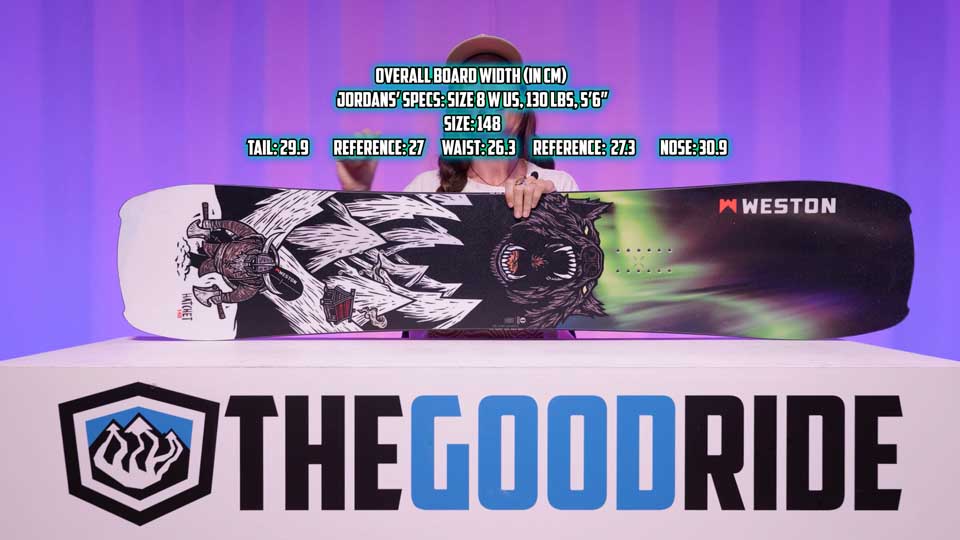
So I was able to get on the 148. This is recommended for 80lbs to about 140lb riders. This is the smallest board that is available in the Hatchet.
This board also rides much bigger than a 48. It is a volume-shifted board. If you typically ride a smaller board, consider the DreamMachine. It is a directional twin instead, to accommodate smaller sizes. The DreamMachine goes all the way down to a 143. This is available in a 148, 152, and 156, but again, it is volume-shifted, so it rides much bigger. This felt like it rode more like a 52, almost 54. What is really interesting about the Hatchet is that its volume shifted; it has a very wide waist width on this. I can almost hide behind this.
The 148, again, is the smallest size that this board comes in, and it has a 26.3 waist width. This accommodates up to a woman’s size 13. So yeah, it’s wide. As a size eight, it definitely felt wide. Given the lack of smaller sizes and the large waist width, I actually place this board more in the men’s category instead of a unisex board, but it can absolutely be ridden by women who have more weight on them or larger feet.
Shape & Setback
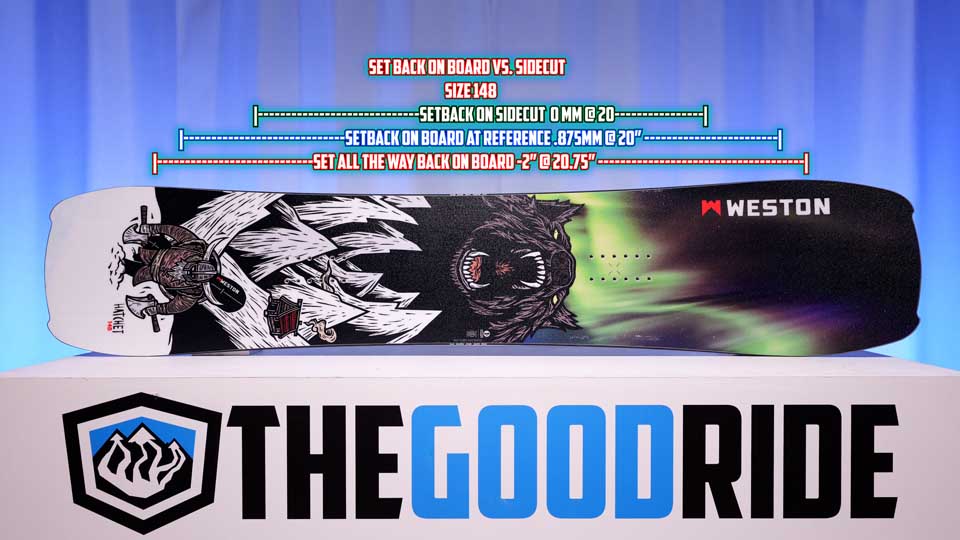
So the Hatchet is a short, fat, volume-shifted twin-ish board. I say it’s twin because if you took this board, you cut it in half, fold it down the middle, it has a twin shape. However, they did do a slight taper of nine millimeters from the tip to the tail and a centered stance. It’s a twin-ish. It’s very similar, but feels like a twin. This is not a setback on board. It is not set back on edge. It is centered on that board, regardless of that slight taper. The board feels and rides a lot like a twin, but you know that taper will help with some powder riding.
So, at reference stance, this board does have a little bit of extra nose, just a little bit of 0.875 on the board at a reference stance of 20in. If you set it all the way back to its furthest inserts, it does increase your stance with the 20.75, but it gives you an extra two inches in the nose. That’s ideal if you wanted to take this into more powder conditions or some lower powder conditions, but two inches is really pretty small for a powder board.
Camber/On Snow Feel
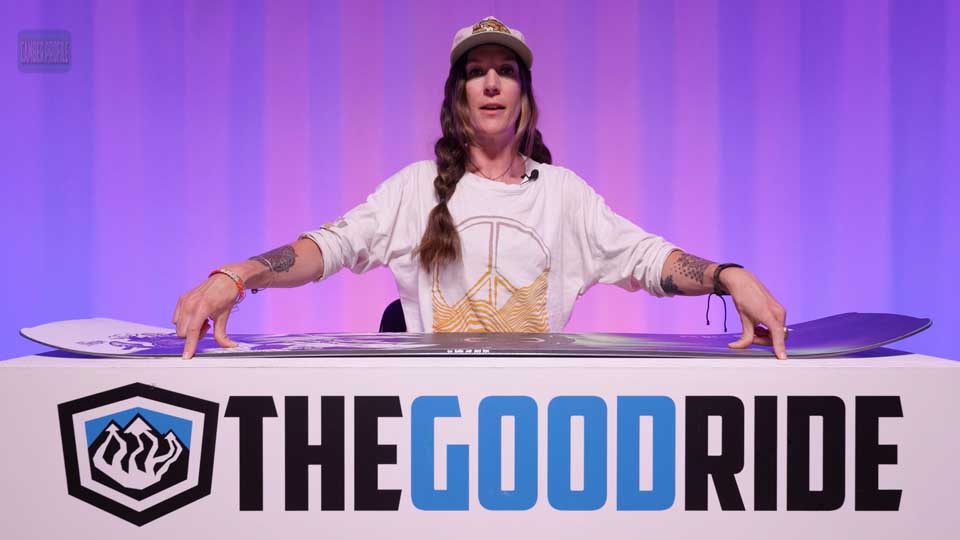
The Hatchet has centered camber just past the inserts with the rocker in the nose and tail. It has about 113 centimeters of effective edge, and the stance is centered on that edge. The board construction includes a wood composition with two sets of carbon stringers that actually run tip to tail on the outside of the toe. This board gives the board incredible stability underfoot, but it also contributes to a heavy feel of the board. Traditional carbon acts as a momentum driver, making turns feel snappier. Interestingly, I didn’t feel that in my turning experience, but the wood core did an amazing job of dampening and gave this board a solid on-snow feel when riding on cat tracks or traversing. It did feel a little bit of catchiness that has been consistent across all the Weston boards I got on.
I tended to transition from edge to edge to avoid that flat basing and feeling that catchy sensation. I contribute a little bit to the construction of the boards, so that it’s a heavier, stiffer board. And usually when you’re flat basing, you’re not able to power into the board and really flex this camber down. This board was capable of skid turns, but it required effort on the rider’s behalf. This board is stiff. It’s a large feeling board that requires effort and skill to ride efficiently. For that reason, I’d recommend this board for intermediate to expert riders who are comfortable with wide camber boards and are experienced enough to ride steeper conditions, or to really throw their weight into their turns.
Edge Hold
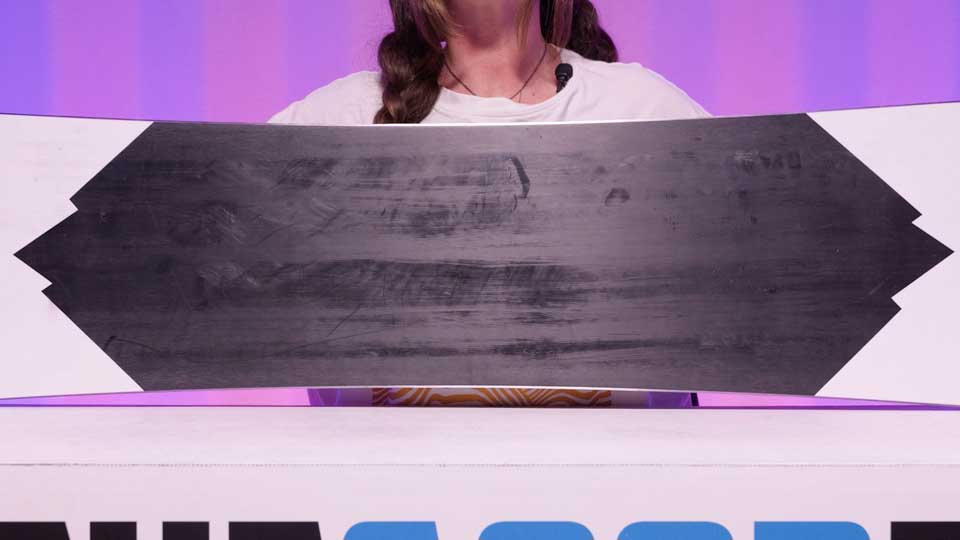
Even though the Hatchet has no visible edge disruption, it had exceptional edge hold on softer pack snow. The edge, especially the heel side, locked in on lower-angle carves and gave me great confidence in its ability to control my turn and my speed. This is likely a result of the wide waist width of the board, which allowed me to get kind of further on to the edge than narrower boards. I actually found myself kind of questioning if I even got onto the edge, and had to go back and look at the footage to actually see that I was getting on the edge. It just was so wide that I could move and lean into that much more than I’ve been able to on the other Weston boards.
However, when the conditions were icier, the edge seemed to slip more. This was more obvious in steeper, tighter terrain where I had to power through my turns. I had the same experience with the Gnarnia and the DreamMachine, and I can attribute it to the stiff flex and the high camber profiles they all share.
Flex Personality
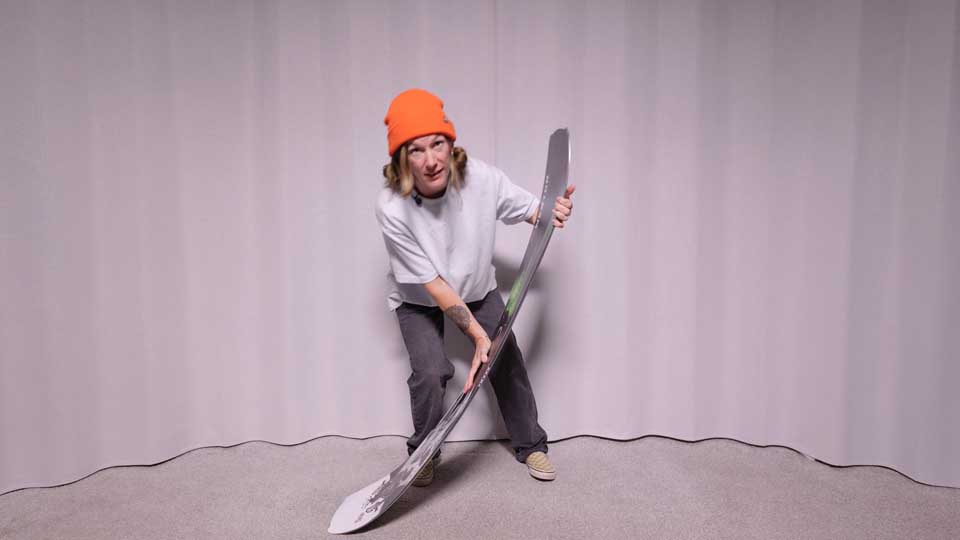
Weston Hatchet, actually, the big surprise for me. Just take a moment here to notice how wide this board actually is.
Flex on this board. Let’s take a look here. Oh, kind of stiff. Definitely mid stiff through that center.
Let’s look at the pop. Pretty good pop. The more power you put into this baby, the more you’re going to get out of it.
If we take it down to the tail here. Oh. Very stiff. Has got quite a bit to it in the tail. Flip it around here. Same with that nose. So stiffer in the tip and tail. It feels universally pretty stiff all the way across the board, but I would say definitely softer through the middle, and almost under the insert feels a little bit softer.
This is a short fat. So this is a wide board, true twin-centered. So it makes sense that you’re going to see center out on both the nose and tail.
Definitely a fun board to ride.
Uneven Snow
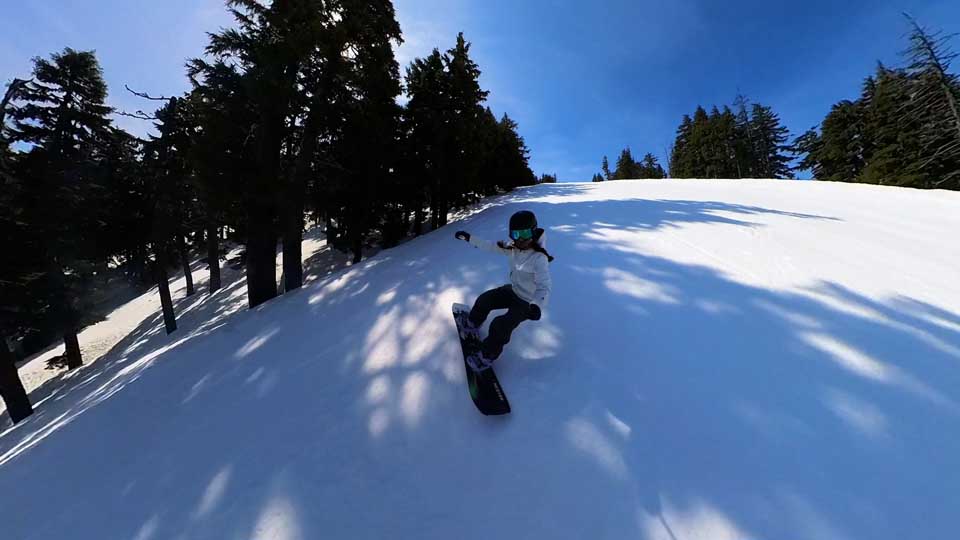
Given the composition of the board, that wood composition of the board, and a little bit of those carbon stringers, it actually did really well on hard, uneven, and even soft uneven snow. It plowed through, absorbed a lot of those bumps and chatter. Where I noticed a compromise a little bit is in how the board was weighted, because it’s a centered weighted board, it kind of feels more like a twin. I really did have to accommodate and shift my weight back to the tail of the board to get over those bumps, but it tracked through a lot of it pretty well. Which is surprising because there is no noticeable dampening tech outside of that wood core and those carbon stringers. It really does have a solid on-snowboard feel.
Turning/Carving
Turn Initiation
Now, I have to admit, I was intimidated by this board. 26.3 wide waist width is one of the widest boards that I’ve gotten on, and I was concerned that the turning experience would be chunky.
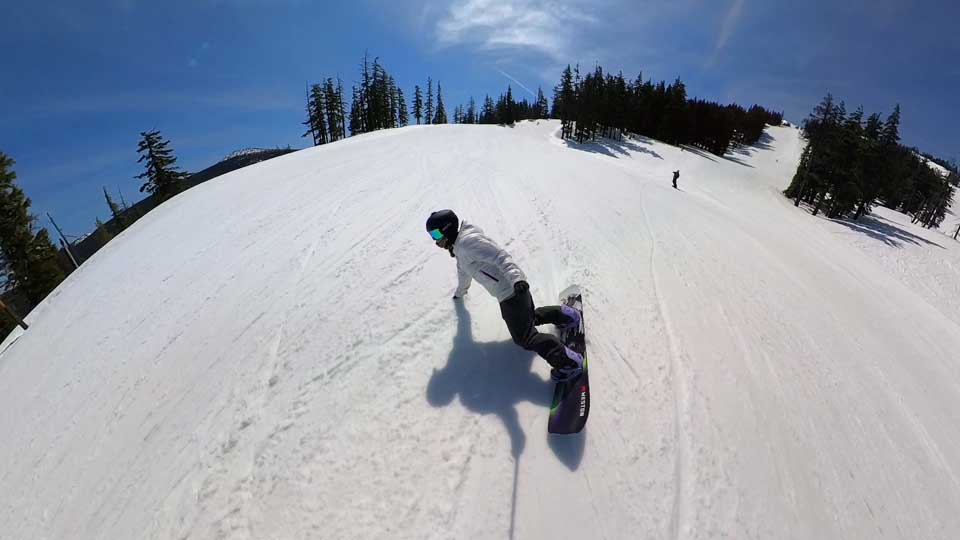
I actually had maybe one of the most surprising experiences on it. The turn initiation is slow. It’s slowed down quite a bit, which makes sense because it has a 7.1 side cut radius across the entire board, which is that middle ground. You couple that with the flex, my weight, and my riding style. The initiation started kind of slow, but the thing about it was that it felt really smooth. I was able to get it onto that edge and hold that edge and then transfer when I wanted to. The board didn’t try to take me anywhere. It just responded in a slower manner, in a calmer manner.
Carving
I was also able to carve this pretty well, and some of the other boards lost the edge hold, especially on lower-angle terrain. This board did pretty well. I actually was more challenged on steeper conditions and icier conditions than I was on lower-angle conditions. I was a little surprised by the turning experience on this, and I was pretty satisfied with how it felt, especially on my heel side. Heel-side turns are a lot harder to lock in.
It’s a lot harder to feel super solid, and this gave me a lot of confidence. I actually kind of leaned really far into that heel side and enjoyed it. It was the best heelside turns I’ve had in a long time. With that said, the speed of the board and its reaction is slow. The board itself is fast, but the turning initiation lacks some of that snappiness that I’ve come to expect with carbon. It didn’t give me playfulness unless, of course, I was really charging and able to flex into that board. Hard camber. So be prepared. If you want this to be playful, you’ve got to put some weight into it. If you want to get some of that snappiness, you really have to have weight and power behind it.
Base Glide
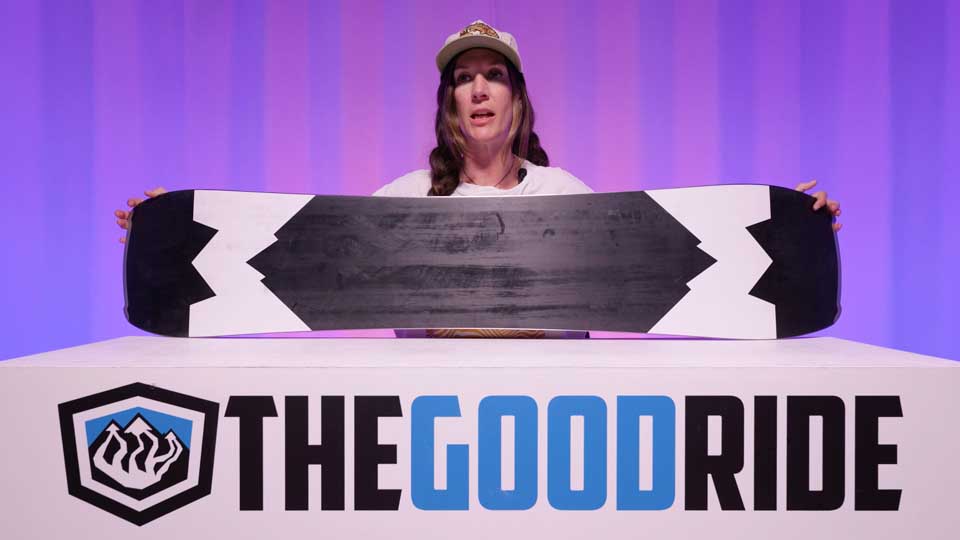
The Hatchet comes equipped with a sintered base, just like its other Weston counterparts that I was able to review, the Gnarnia and the DreamMachine.
This board was given to us as a demo board with factory wax.
It lacked a little bit of base glide.
She was dry like the Serengeti, so I definitely had to get some wax on the board. With temperature-specific wax, the board improved significantly.
This board will benefit from regular specific waxes and professional tuning from time to time.
Powder
Now, I wasn’t able to get this board into powder conditions. By the time I was on it, we were in late spring conditions. Given its shape, its width, and the volume of the board, I imagine that this probably has quite a bit of float. However, even set back all the way, it only has two inches of nose and just a mild amount of taper that will allow the tail to drop and the nose to lift. But I imagine it also has some divey feelings to it, especially if you’re getting in really deep snow, and especially if you transfer your weight slightly forward instead of keeping it all the way in the back.
Now, my big question would be, and again, didn’t able to get it into trees in powder setting, is that it felt very slow to turn. And because it felt slower to turn, I imagine that it probably feels a little hard to throw in trees, especially when you need to keep speed up in powder conditions, and you need to react quickly.
Ideal situation with this board, you know, get it in big open powder fields would be wonderful. Steep open powder conditions, I think this board would really shine. In tighter trees, it could feel like a little bit too much board. It could feel like it’s trying to control and drive you downhill instead of letting you kind of be quick and maneuver through tight trees. I recommend keeping this on steep powder terrain, but riding in lower angle on groomed or a small amount of uneven powder.
Final Thoughts
Overall, the Hatchet actually was the most enjoyable experience for me out of all of the Weston boards. Maybe that’s because I came into it with false pretenses that it was going to be too much board, but maybe it was also just because it’s a really fun board to ride.
A 26.3 waist width at a 148 is unheard of. Having something that wide allows somebody like me, who has a smaller foot, to really lean and get into that edge, making for a wonderful turning and carving experience. You couple that with a camber profile, slight taper, a little bit of ability to set this back and get some extra nose, and it’s a pretty versatile kind of freeride freestyle board.
The perfect person for this is going to be someone who is in a bigger, more consequential terrain. Somebody who likes wide or volume-shifted boards, and somebody who has maybe a little bit more weight to them or a larger foot. Definitely recommend this for an advanced intermediate rider to an expert rider, just based on the stiff flex, or somebody who is in more consequential terrain or has steeper conditions that they’re trying to navigate. Your Tahoes or Colorados, your Utahs, places where you’re maybe dropping cliffs a little bit more. Not as much in my backyard.
If you like our reviews, please like and share.
That always helps us.
And if you’re looking for some advice on the boards that you want, I am happy to help in any way I can. I have a lot of years of experience helping people get on the right board, and that’s what I love to do.
Weston Hatchet Specs
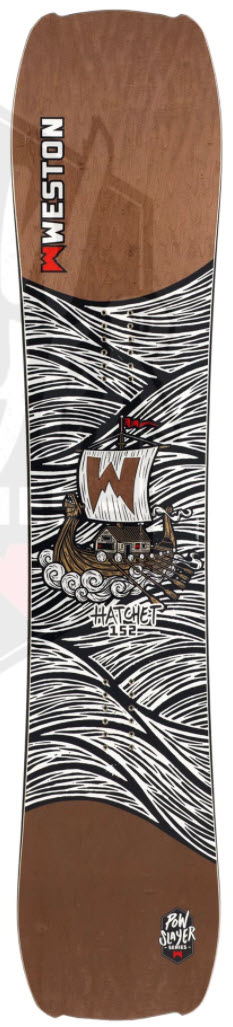
Weston Hatchet Images
We try to get as many images of the Weston Hatchet, but forgive us if they're not all there.
2021
Weston Hatchet User Reviews
Where To Buy
No obligation, but these links support the site.
Weston
evo
Outdoor Gear Exchange
SnowCountry
Weston
evo
Outdoor Gear Exchange
SnowCountry
No Results Found
Where To Buy
No obligation, but these links support the site.
Weston
evo
Outdoor Gear Exchange
SnowCountry
No Results Found